Understanding Denzing
Introduction
Denzing operates on an agentic system with autonomous Agents that collaborate to understand, analyze, and respond to business questions. Instead of following a fixed sequence of steps, this system is goal-oriented, dynamic, and iterative. Each Agent approaches a problem the way a human analyst would by first understanding the question, creating a plan, executing tasks, evaluating results, and refining the approach if needed.
At its core, this system is built on coordination. A central Agent oversees a group of specialized Workers, each responsible for a specific type of task such as planning, data extraction, analysis, visualization, and explanation. These components work together through a shared state, continuously updating context and results until a complete and accurate answer is produced.
Why the Agentic System?
Traditional analytics systems are linear and rigid. They rely on predefined dashboards, static queries, and manual interpretation. This creates delays, limits flexibility, and often results in incomplete or outdated insights. More importantly, these systems require users or analysts to do the reasoning themselves.
Denzing’s agentic system removes these limitations by introducing adaptive intelligence into the process. Instead of executing a single query, the system can break down complex questions, run multiple steps, validate outputs, and adjust its approach when needed. This makes it significantly more reliable for real-world business questions that are rarely straightforward.
Because the system evaluates its own outputs and can replan when something fails, it is more resilient than traditional pipelines. It reduces the risk of incorrect answers, improves accuracy over time, and provides transparency into how conclusions are reached. The result is a system that behaves less like a tool and more like a capable data team.
Core Concepts
Agent
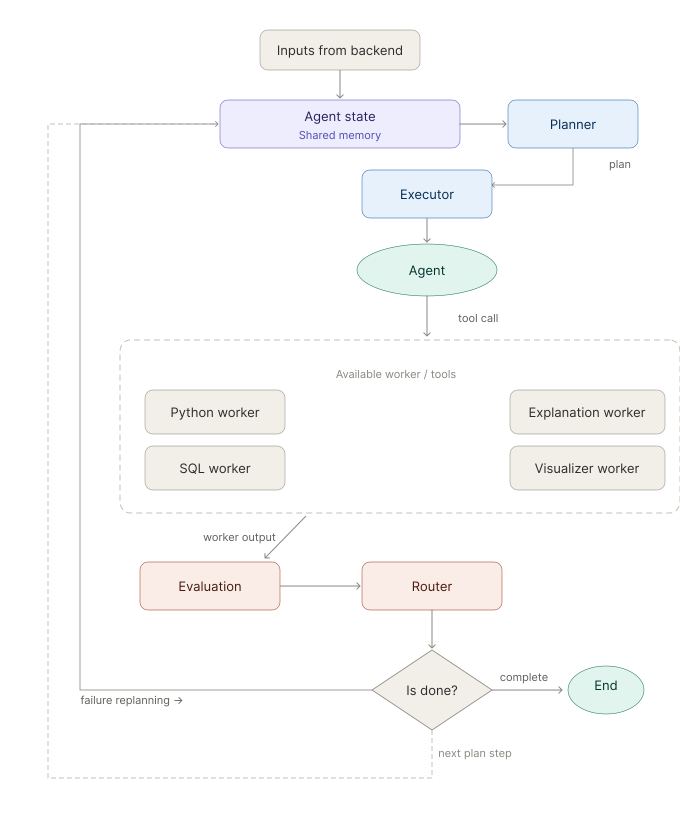
The primary interface that users interact with. An Agent represents a role or function and is responsible for coordinating the full analytical process from question to answer.
Agent State
A shared memory layer that stores the question, data references, context, intermediate outputs, and final results. Every part of the system reads from and writes to this state, ensuring continuity and context throughout execution.
Planner
Responsible for interpreting the question and creating a structured plan. It decides which tasks need to be performed and which Workers should be involved.
Executor
Carries out the plan step by step by invoking the appropriate Workers. It focuses on execution rather than evaluation.
Evaluator
Assesses the quality and completeness of outputs. It determines whether results are valid and whether the system can proceed or needs to adjust.
Router
Controls the flow of the system. Based on evaluation results, it decides whether to continue execution, replan, or finalize the answer.
Workers
Specialized components that perform specific tasks. Examples include querying data, processing datasets, generating visualizations, forecasting outcomes, and explaining results in natural language.
Replanning
If a step fails or produces incomplete results, the system can revise its plan using the knowledge of what went wrong. This allows it to recover and improve its approach dynamically.
How It Works
- Input
- User asks a question
- System receives data source, Agent configuration, and context
- Plan
- Planner creates a step-by-step strategy
- Execute
- Executor calls Workers to perform tasks
- Data is retrieved, processed, and analyzed
- Evaluate
- Outputs are checked for accuracy and relevance
- Route
- Continue execution, replan, or finalize
- Synthesize
- Final answer is generated with clear explanation and supporting outputs
Denzing’s agentic system transforms analytics from a static, query-driven process into a dynamic, reasoning-driven system. By combining planning, execution, evaluation, and continuous learning, it enables organizations to move from data access to true understanding.